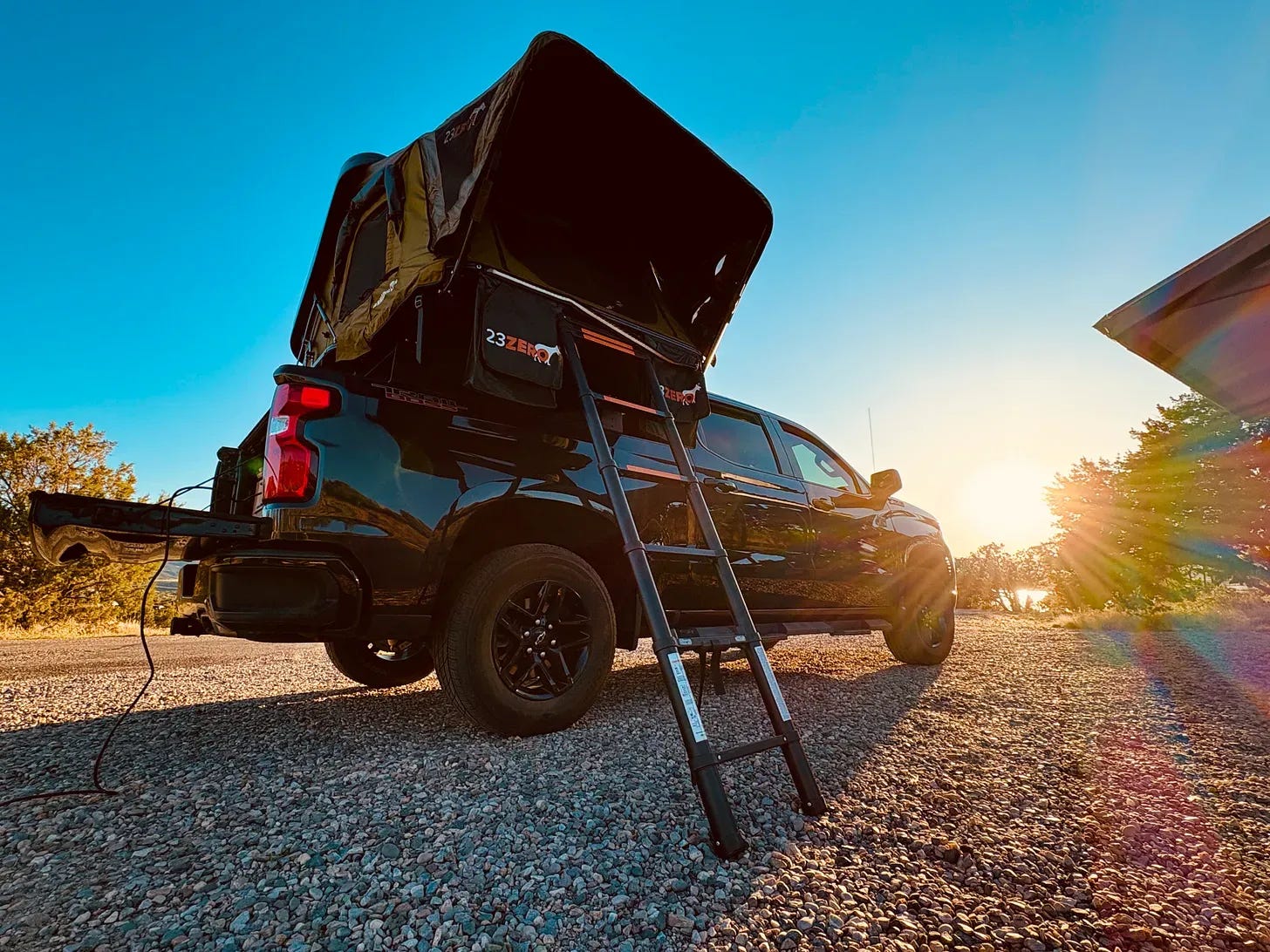
Living in a Roof Top Tent
Here's a look at our unconventional lifestyle and what we call home.
“That’s an interesting and unique way to do it”, was a comment from an older RVer at our recent stay at the KOA in Grand Junction, Colorado.
The man, probably in his 70s, was admiring our grit and spirit for taking an unconventional approach to our road-life adventure, while confirming we made the right decision not to haul around a large rig, based on his list of complaints about driving and maintaining a $500,000 RV.
It’s become quite humorous as we stop at RV parks and campgrounds across the country, because unless we’re in places where RTTs (rooftop tents) are popular, there’s always someone intrigued by our mobile home choice.
People want to know what the experience is like, why we chose this method of travel, or ask for recommendations on which brands to consider.
So today, I’m going to answer some of the most common questions we get and share more about our experiences so far, just in case you might want to do the same.
Why a rooftop tent and truck?
The biggest reason we chose our Silverado 1500 Trail Boss and our 23 Zero RTT for adventure travel was based on price.
Because we already had a truck and hotels were getting expensive, we invested a total of $4,500 in the RTT and the Billie Bars. This gives us the ability to truck camp for free on public and BLM lands or spend less money (often $30 or less per night) at cheaper RV parks that allow us to stay.1
The second reason we love this option is due to mobility.
Having watched numerous RVs and trailers struggle to find parking or maneuver in tight spaces, we didn’t want to deal with the added stress of those challenges, and, with anxiety sometimes driving in the mountains, pulling a rig was not an option!
The third reason for our decision was less hassle and maintenance.
Every person I’ve talked with who hauls a rig or drives a motorhome talks about the never-ending frustrations of things that go wrong. Screw that! Our setup is quick and easy, requiring little maintenance.
And the last reason is way better gas mileage.
Unless it’s windy or we’re driving the hills, we average 18 mpg, but on good days we can get 24 mpg, fully loaded at 6,000 lbs. Compare that with the man I talked with in Grand Junction, who is lucky to get 6 mpg. We save more money.


What’s it like living in a rooftop tent?
In full disclosure, we don’t always live in our RTT; we break up our travel adventures by staying in hotels and resorts if they’re affordable, or by crashing at our friends’ houses if they want to put up with us. But overall, it’s bittersweet.
On one hand, it’s awesome to pull up to a great location off the beaten path near lakes, mountains, and beaches, while enjoying the outdoor life all around us. Our RTT is spacious enough for both of us to store some gear and sleep in, plus we can be ready to camp in five minutes or less. Our views are typically stunning, so we enjoy them.
On the other hand, being in our mid-50s, we lack consistent comfort and sometimes experience cold weather, which takes a toll on our bodies. It’s not fun trekking down the ladder to pee in the middle of the night, especially after a few beers. And even though it’s six feet off the ground, it’s not entirely safe and secure like a trailer.
Also, because most of our gear is stored under a hardtop tonneau cover, it can be a real pain in the ass to get everything we need out.
In my opinion, this is a cost-effective short-term solution designed for short excursions or people who are younger and have stronger bladders. 😂 But it’s still doable for older people who implement a great mattress, use a heater, and run a funnel with a hose from inside the tent to a pee bottle outside.
What brands of RTTs do I recommend?
Honestly, I don’t know all the brands or options available on the market today, but I thoroughly researched the industry leaders, ROAM, Roofnest, iKamper, and 23 Zero before deciding on the 23 Zero Armadillo X2 in early 2024.
For the most part, we liked our X2, but we recently noticed defects and problems that cannot be fixed, which is frustrating given it’s only a year old! Thankfully, we were offered an upgrade to the new Armadillo AX3 model if we paid the difference and shipping, but I chose a free replacement with the A2 version.2
I can say that as we travel, the most popular RTT brands I see on vehicles are 23 Zero or iKamper, though there are many cheaper knockoffs I haven’t heard of.
Additionally, I’ve learned hard-shell RTTs are the way to go because they’re better designed and last longer, are faster to set up, and are more dependable in high winds, but they’re also more expensive and heavier.
My recommendation is to research the product’s reliability, warranty, and customer service before purchasing it.
Would we do anything different?
Oh hell yes!
For starters, we never considered buying a camper van back in 2020 when we began our adventure. Purchasing a converted Mercedes Sprinter or Ford Transit would have made way better sense for us, even with the higher price tag.
When you consider all the options you can get with living in a travel van, paired with the ability to park almost anywhere to sleep regardless of the climate, this would have saved us a ton of money long-term and been easier for our lifestyle.
The next best option I would’ve considered is a Lone Peak Camper, which we may upgrade to this year; it would be closer to a travel van setup. This product allows more space and easier access to our gear, plus it includes an RTT.
Lastly, I would’ve ripped out that worthless and uncomfortable mattress in the Armadillo X2 and replaced it with something thicker, or at least, found a better sleeping mat to put on top, as long as the shell could close. Getting good sleep makes a huge difference in your life, and this is not always possible with an RTT.
Living from a vehicle, whether it’s a truck or a car, is a great way to experience life and see the world. If you do it right, you can save a lot of money and enjoy incredible freedom as you explore new places. And it’s finally starting to be accepted as something normal and not weird, though we don’t give a damn what others think.
Yet it’s not a perfect situation either and it’s not always easy. Some challenges come with this kind of nomadic lifestyle, and if you’re not adaptable or flexible with your plans, it can get frustrating.
But we wouldn’t trade the experience for anything!
If you’ve ever considered this unconventional way of living, go ahead and take that leap of faith into the unknown to see what it’s like, because you will never know without doing it.
That’s it for today.
Feel free to ask questions and share your comments below.
Some RV parks do not allow truck camping or rooftop tents for whatever reason. Always check with their rules before showing up!
3 Zero recently discontinued the Armadillo X2, X2, A2, and A3 from their product line, perhaps because of problems or defects, or just because of their new models being released.