

Next Chapter Camper Van Review
Our thoughts about this camper van company from Ramona, Oklahoma.

On July 3rd, 2025, after a horrible experience trying to buy a camper van from a company in Rifle, Colorado, we accidentally discovered a local van builder in Ramona, Oklahoma, during our desperate search for a new option.
And now that we’ve been living in our camper van for two weeks, it’s time for us to share our thoughts on the company that made our dream a reality.
Welcome to Next Chapter
Doug Smith, owner of Next Chapter Camper Vans, spent 20 years in Corporate America. The company he worked for was eventually sold, resulting in his termination. Rather than seek employment elsewhere or retire, he decided to take a leap of faith and build a business to help others live their traveling dreams.


It’s your chance to get away, to go wherever you want, whenever you want.
When I first spoke with Doug by phone, I immediately sensed that his heart and soul were in this business. He focused on building camper vans that could operate off the grid while remaining affordable for people seeking their own adventure. Of course, this also meant cutting out all the extra fluff that many other van enthusiasts add to their products, which was perfectly fine with me.
He had me hooked!
We drove two hours to his shop to meet him in person and see if the actual product lived up to the online hype. We were not disappointed.
The 2023 Ram Promaster
Next Chapter only provides van customizations for the Ram ProMaster chassis. They will even find a used van for you for a great price.
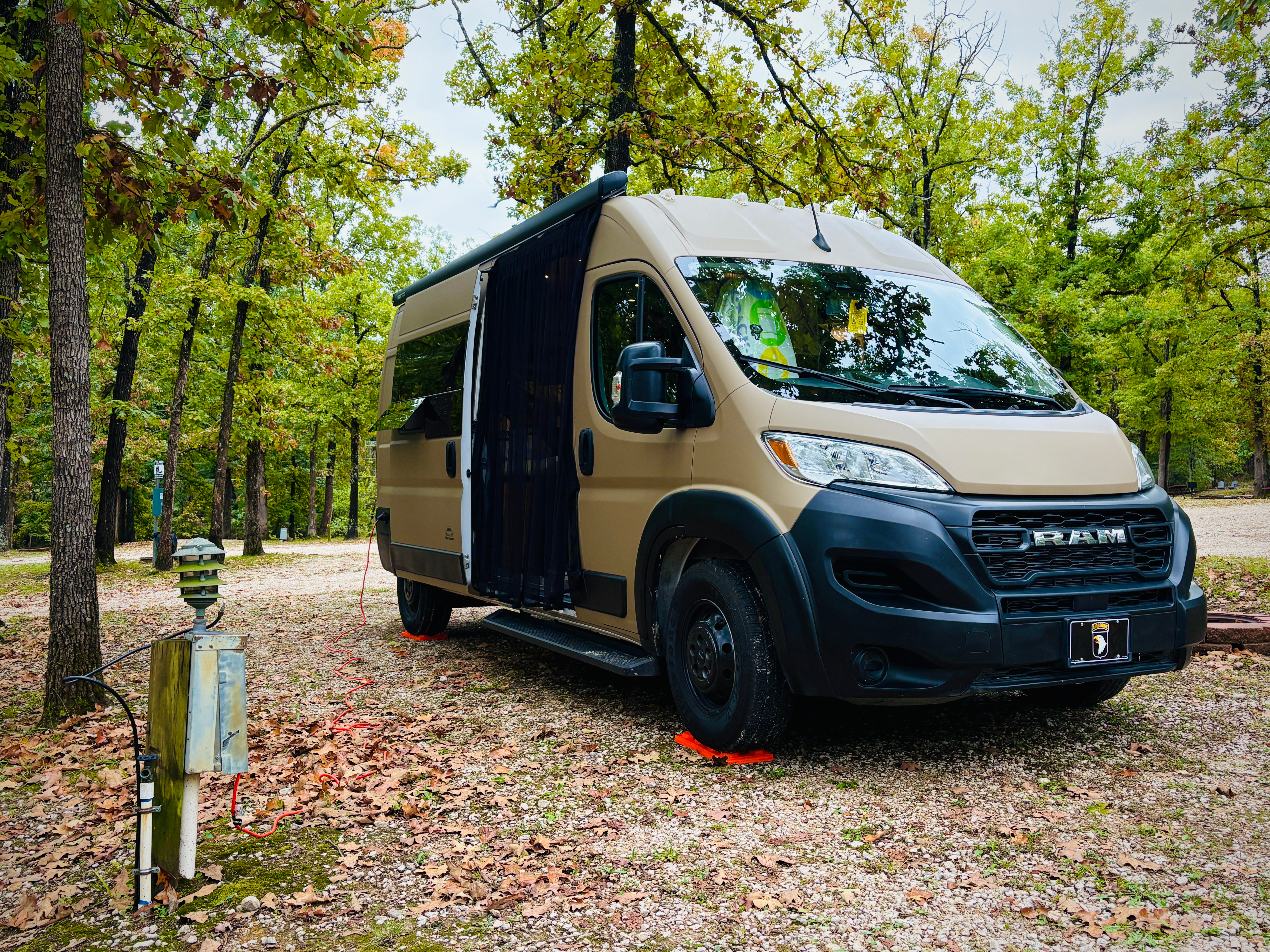
We decided on the 2500 with a 159” wheel base, the most common model for van lifers because it’s 18 inches shorter than a 3500 series, making it easier to drive and park in tight spaces. It’s 19.6 feet from nose to tail and turns on a dime.
Switching from a Chevy Silverado 1500 5.3L EcoTec3 V8 engine to a high-roof commercial van with a 3.6L Pentastar V6 has been a significant change.
The power decrease is noticeable, especially when driving uphill, and the van sways a lot in strong winds. We’ve also seen a slight drop in MPG due to the extra weight we carry, but it’s not a big difference compared to our truck. Additionally, I wish Promasters offered AWD or 4WD, as I’m not entirely convinced about the FWD.
We had a desert-tan vehicle wrap installed, giving us a subtle military and outdoor vibe while allowing us to add custom graphics and advertising in the near future. The feedback from people has been very positive.
Unfortunately, the van purchased for our build had a faulty TPS monitor, a broken tag light, issues with the Uconnect and GPS, and was badly in need of an oil change and detailing. I wish these problems had been solved before we picked up the van at Next Chapter, but otherwise, we like it.
The Custom Build
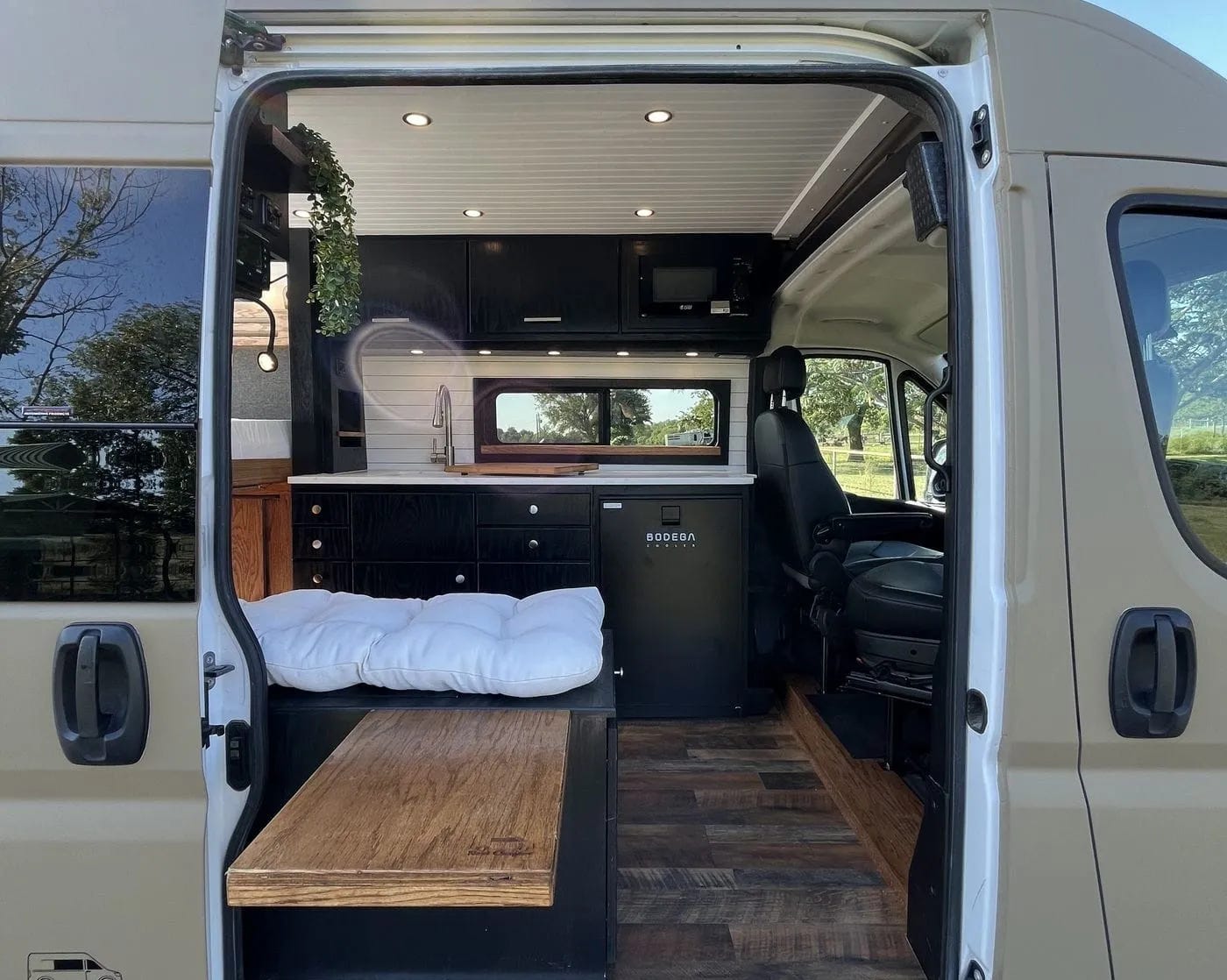
Doug and his team did an excellent job on the build. Nearly everywhere we stop, people comment on how great it looks.
The cabinets are crafted from oak and high-quality materials to deliver durability and a luxurious look. They offer more storage than other camper vans, and the heavy-duty magnets keep your belongings secure, preventing accidental opening during travel.
We chose a semi-gloss black paint and brushed-nickel fixtures, along with white shiplap for the backsplash. The floors are real wood with a darker finish, and the ceiling is flat white with plenty of track lighting and dimmers.
The bed is very comfortable with 8” of memory foam, and even in an RV queen size, Donetta and I have plenty of space when we don’t want to snuggle. For private moments of fun, I highly recommend wearing a rubber helmet or being very aware of the low ceiling. Explaining those bumps and bruises all over your head might be very awkward. 🤭
Overall, we love the entire look and feel of our camper van. Our only complaints are minor cosmetic issues that are easy to fix.


The Features
I want to provide a breakdown of key features and explain why they differ from many other Class B Camper Vans on the market.
20 Gallon Water Tank and Heater
At first, I didn’t care much about this, especially since many RVers struggle with water tanks, and I have two nearly indestructible 5-gallon Scepter cans that keep water cold. But I really like what Next Chapter did here!
The 20 gallon tank is located on the rear driver's side and is easily accessible through the custom cabinets. It includes an outdoor shower sprayer, a simple hose connector, and a 2-gallon hot water tank that takes about 10 minutes to heat. It’s also very easy to winterize if we stop traveling in the colder climates. It’s easy to fill up and saves me from hauling water cans around.
At light use (washing dishes, wetting our hair, brushing our teeth), it takes us four days for the water to be halfway gone.
5 Gallon Porta-Potty
Having a toilet feels like a waste of space. Besides, who wants to drop a stinky in the place where they eat?
Regardless, our van came equipped with a portable SereneLife 5.2-gallon toilet that’s easy to fill, use, dump, and clean. It’s not fancy but does the job. And despite the awkwardness of learning to squat in a van to take a leak, it’s been handy for us, especially on those nights I’ve had too many beers and don’t leave the vehicle.
There are portable composting toilet upgrades to consider, and we might explore that option in the future, but for now, this one works and we’re glad we have it.
Bodega Cooler
Next Chapter Vans includes a smaller fridge in the buildout price, but because we travel full-time, we opted for a larger Bodega upgrade for $250. The downside is that there still isn’t enough space, and it doesn’t always perform well, so we’ve brought our BougeRV CRD Portable Dual Fridge for meat, ice cream, and extra beers.
Sink with 5 Gallon Tank
This was a required feature, no matter how basic it was.
In our build, the sink aspirator draws water from the 20-gallon tank, dispenses it through the faucet, and then drains it into a 5-gallon plastic jerry can below. We empty the drain water every couple of days to keep it from getting too heavy or smelly. It’s a hassle-free setup with minimal risk of issues. We can also cover the sink with the wood cutting board provided by Next Chapter.
I’ll also add that we love the countertop and the space. It’s perfect for food preparation or as a standing desk. Plus, there are under-the-counter track lights with a dimmer, making this a nice spot to display some decorations.
Microwave
This feature wasn’t a big deal for us, but it’s been useful the few times we’ve used it.
Power Source
This was the most critical aspect of our van build because having the ability to boondock or be off the grid is mandatory.
We have two Eco-Worthy Lithium Battery Bluetooths at 12V/280Ah/3,584Wh, along with a 450-watt solar panel to generate power. Our inverter is an Ardroit and our battery monitor is a Redarc. The batteries can be recharged while driving, via solar power, or via shore power. Truth be told, I don’t know much about these things, but it seems to be working great so far!
While boondocking, we lost only 15%-20% of our batteries on a 12-hour night run, including the air conditioner and two fridges. However, if we keep the heater running on cold nights, it will drop by 50% or more overnight.
12 Volt Air Conditioner and Heater
While we could suffer in cold or hot weather, we didn’t want to compromise on this feature, even if we used it sparingly.
Unfortunately, we don’t know the make or model, or how all the features work, but it does a great job — sometimes it’s so cold lying on the bed, that my nipples get so hard that they reach the ceiling. The downside is that the temperature is consistent around the bed area, but there can be a 10-20-degree difference at the front of the van.
That said, we are glad we have this, as in our first two months with the van, we encountered very hot and very cold weather.
The Price
Many people are hesitant to share what they paid for a high-end product, but it’s worth noting the price relative to other options. Not to mention, you can easily find prices on his website.
The investment price for our van and build was $85,000 USD.
At first glance, this may seem like a lot of money, and it is. Still, when you consider that other van companies are selling their converted vans for an average of $120,000 and up, Next Chapter is an incredible deal.
Could you source it and build it yourself at a lower cost? Absolutely. But this also requires upfront cash, tools, knowledge, and time — none of which we had. At our age, we decided to finance it so we could get going ASAP.
Customer Support
Here’s one more thing I really appreciate about Next Chapter Camper Vans ... their customer support.
We’ve had a few minor issues, but Doug fixed them immediately! He’s always responsive when we text or call, and I know he’s traveled to other customers on his own dime to help with their van problems, even when it had nothing to do with the actual build itself. This means everything!
In an industry where customer support sucks, Next Chapter has excelled. It’s not perfect, but it’s close. And we appreciate that.
Overall Experience and Feelings
If I were rating our experience and satisfaction with this purchase on a five-point scale, I’d give it 4.5 overall. We really do love our van!
While there were a few annoying things with the camper van build process and the finished product, we have absolutely zero regrets. Doug and his team did a fantastic job and we’re happy to have worked with them. The biggest drawback, in my opinion, was that I didn’t get to see the used van before it was purchased or have it inspected.
If you decide van life is for you and you’d like to know more, reach out to Doug Smith at Next Chapter Camper Vans. Please tell him Road Life Adventure sent you.